Researchers have discovered the secret of the Mediterranean
diet:
(Written by Amalia Negreponti)
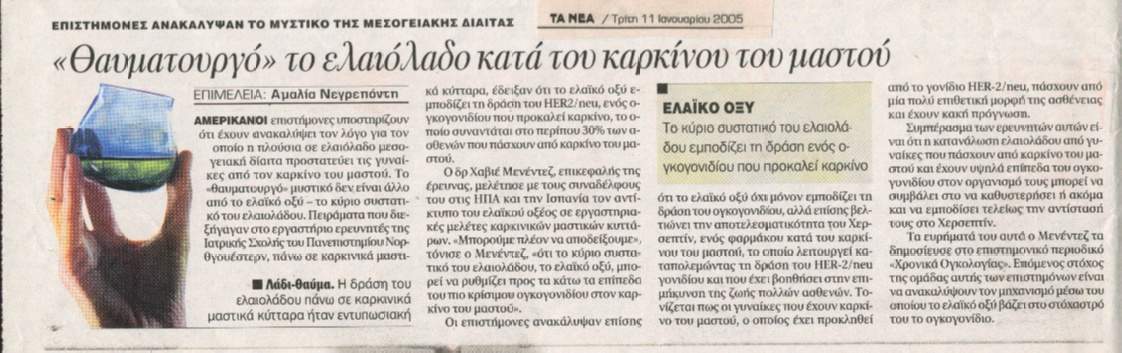
American researchers claim that they have discovered the role that olive oil
exerts in the protection against breast cancer, mainly found in the
Mediterranean diet. The "miraculous" secret is based on the oleic acid
the main constituent of olive oil. Experiments contacted on cancer cells in
laboratories of Northwestern University Medical School, show that oleic acid
inhibits the action of HER2/neu. This is a tumor gene that causes cancer in
approximately 30% of breast tumor patients.
Dr. Havie Menendez, in charge of the research, studied together with his
colleagues in the USA and Spain the therapeutic action of the oleic acid
in laboratory studies using breast cells. Dr Menendez said that " now we are in
a position to prove that the main constituent of olive oil, oleic acid is
responsible for the prevention of breast tumors, by controlling the levels of
the HER2/neu tumor genes in low levels.
The researchers also discovered that oleic acid not only inhibits the
action of the breast tumor cells but also helps in the medicinal aid of the drug
Herceptin, a drug that is given to breast tumor patients that has helped
prolonged patients life.
Conclusion: Patients that consume olive oil may delay or completely inhibit
the action of the tumor cells parallel to the use of Herceptin.
Dr. Menendez published his findings in the Medical Journal of " Chronicle of
Oncology". His next study is to trace the exact mechanism that oleic acid
actually uses to fight against and inhibit the tumor cells action.
Olive Oil, the world’s most commonly eaten
mono-unsaturated oil, has been enjoyed for many thousands of years around the
Mediterranean. Not only does it taste good, but there is a mass of evidence that
a diet based on olive oil can promote longer life and may prevent some of the
diseases associated with our usual western eating pattern.
In recent years, medical researchers have
turned their attention to the virtues of the Mediterranean style of eating and
to olive oil. On closer inspection, this ancient oil has proved to be more than
just a source of mono-unsaturated fat. It is also a rich source of
antioxidants—substances now attracting great scientific attention.
Olive oil contains a wide variety of valuable antioxidants
that are not found in other oils.
Epidemiological studies suggest that olive oil has a
protective effect against certain malignant tumours in the breast, prostate,
endometrium and digestive tract. Research has revealed that the “type” rather
than the “quantity” of fat seems to have more implications for cancer
incidence. This could be related to oleic acid, which is the predominant
mono-unsaturated fatty acid in olive oil.
It has been demonstrated that the addition of olive oil to
a diet that is not changed in any other way has a lowering effect on blood
pressure.
An olive oil rich diet is not only a good alternative in
the treatment of diabetes; it may also help to prevent or delay the onset of
the disease by preventing insulin resistance and its possible harmful
implications by raising HDL cholesterol, lowering triglycerides, and ensuring
better blood sugar level control and lower blood pressure.
Like all other fats and oils olive oil is high in calories
which could suggest that it would contribute to obesity. However, evidence
shows that there is less obesity amongst Mediterranean people, who consume the
most olive oil in the world. It has been demonstrated that an olive oil rich
diet leads to greater and long lasting weight loss than a low fat diet. Olive
oil tastes good and it is a stimulus to eat vegetables and pulses.
Olive oil bolsters the immune system against external
attacks from microorganisms, bacteria or viruses. The fatty acids in olive oil
are good allies in lowering important immunological parameters.
Olive oil is also good for the stomach, hepato-bilary
system, pancreas, and intestines. It helps with anti-aging, osteoporosis,
cognitive function and skin damage. It is also beneficial to consume olive oil
during pregnancy and whilst breast feeding.
A small study from Greece has reported for the
first time that dietary supplementation with the
olive extract, oleuropein, could boost
blood flow and reduce heart attack risk. The new research, conducted with
rabbits and published in the August issue of the
Journal of Nutrition, claims to be the first experimental study in vivo
that suggests the possibility of using an oleuropein to improve blood flow and
boost cardiovascular health. Dietary supplements containing oleuropein are
currently available in Europe by Belgian company
BioActor.
NEW YORK (Reuters Health) - People who use plenty of olive oil in
their diets may be helping to prevent damage to body cells that can
eventually lead to cancer, new research suggests.
In a study of 182 European men, researchers found evidence that
olive oil can reduce oxidative damage to cells' genetic
material, a process that can initiate cancer development.
They say the findings may help explain why rates of several
cancers are higher in Northern Europe than in Southern Europe, where
olive oil is a dietary staple.
They also support advice to replace saturated fats from foods
like meat and butter with vegetable fats, particularly olive oil,
said study co-author Dr. Henrik E. Poulsen, of Copenhagen University
Hospital in Denmark.
He and his colleagues report the findings in The FASEB Journal, a
publication of the Federation of American Societies for Experimental
Biology.
The study included healthy men between the ages of 20 and 60 from
five European countries. For two weeks, the men consumed a quarter
cup of olive oil throughout each day. At the end of the study, they
showed an average 13 percent reduction in a substance called 8oxodG,
which is a marker of oxidative damage to cells' DNA.
Such damage occurs when byproducts of metabolism called reactive
oxygen species overwhelm the body's antioxidant defenses. Olive oil
contains a number of compounds, called phenols, believed to act as
powerful antioxidants.
However, those compounds didn't seem to account for the drop in
DNA oxidative damage, according to Poulsen's team. The men in the
study used three different olive oils with varying levels of
antioxidant phenols, and oxidative damage declined regardless of the
phenol content.
Instead, the researchers suspect that the monounsaturated fats in
olive oil are behind the effect.
The findings, they say, suggest that olive oil may be part of the
reason that certain cancers, including breast, colon, ovarian and
prostate cancers, are less common in Mediterranean countries than in
Northern Europe.
At the beginning of the study, men from Northern Europe had
higher levels of 8oxodG than those from Southern Europe. This is
consistent, according to Poulsen's team, with the expected effects
of the olive-oil-rich "Mediterranean diet."
However, Poulsen told Reuters Health, the diet is more than just
olive oil. Ideally, it's also rich in fruits, vegetables, whole
grains and fish.
Moreover, regardless of its benefits, he added, olive oil is no
substitute for calorie control and regular exercise.
When it comes to heart health, virgin olive oil may have an edge
over other vegetable fats, new research suggests.
Reporting in the Annals of Internal Medicine, European researchers
say virgin olive oil may be particularly effective at lowering heart
disease risk because of its high level of antioxidant plant
compounds.
In a study of 200 healthy men, the researchers found that virgin
olive oil -- rich in antioxidants called polyphenols -- showed
stronger heart-health effects than the more extensively processed
"non-virgin" variety.
The findings suggest that virgin olive oil has more going for it
than its supply of heart-healthy monounsaturated fat, according to
the study authors. Polyphenols, they say, may account for some of
the health benefits that have been attributed to the oil.
In fact, virgin olive oil is the only vegetable oil that's rich in
polyphenols, Dr. Maria-Isabel Covas, the study's lead researcher,
told Reuters Health.
"All vegetable oils other than virgin olive oil are submitted to a
(refining) process in which polyphenols are practically lost,"
explained Covas, a researcher at the Municipal Institute for Medical
Research in Barcelona, Spain.
Even "ordinary" olive oil has a lower polyphenol content, she noted,
because it's a mixture of virgin olive oil and a more-processed form
of the oil.
For their study, Covas and her colleagues had 200 young and
middle-aged men use each of three olive oils for three weeks apiece.
One oil was a virgin olive oil high in polyphenols; the other two
were more heavily processed varieties with moderate to low
polyphenol levels.
The men used the oils in place of other dietary fats.
At the end of the study, the researchers found that the men's levels
of "good" HDL cholesterol were highest after their three weeks on
virgin olive oil. They also showed a greater decline in markers of
so-called oxidative stress -- a process that helps deposit particles
of "bad" LDL cholesterol on the artery walls and can lead to a
hardening and narrowing of the vessels supplying the heart.
Monounsaturated fat is well known to be a healthier alternative to
the saturated fat found in animal products like butter, Covas noted.
That fact, along with the benefits of polyphenols, she said, make
olive oil "a good source of fat."
But she stopped short of recommending virgin olive oil as a
replacement for other vegetable oils, saying large clinical trials
are needed to see whether there's a health advantage.
SOURCE: Annals of Internal Medicine, September 5, 2006.
Studies show that the Mediterranean Diet: is associated with
lower risk of developing Alzheimer's disease.
The Mediterranean Diet... has been associated with lower risk for
several forms of cancer, obesity, dyslipidemia, hypertension,
abnormal glucose metabolism, coronary heart disease, and overall
mortality. In a recent study, we demonstrated that higher adherence
to the Med Diet at baseline evaluation was associated with lower
risk of developing Alzheimer's disease during follow-up. Similarly
to our previous findings, in this different Alzheimer's disease
population we observe that higher adherence to the Med Diet is
associated with reduced disease odds.
--Mediterranean Diet, Alzheimer Disease, and
Vascular Mediation. Scarmeas, N., Stern, Y., et al. Archives of
Neurology 63 (2006).
Improves overall health and lowers rates of
cancer incidence in obese people.
A systematic review was made and a total of 43 articles
corresponding to 35 different experimental studies were selected.
Results were analyzed for the effects of the Mediterranean diet on
lipoproteins, endothelial resistance, diabetes and antioxidative
capacity, cardiovascular diseases, arthritis, cancer, body
composition, and psychological function. The Mediterranean diet
showed favorable effects on lipoprotein levels, endothelium
vasodilatation, insulin resistance, metabolic syndrome, antioxidant
capacity, myocardial and cardiovascular mortality, and cancer
incidence in obese patients and in those with previous myocardial
infarction.
--Scientific Evidence of Interventions Using
the Mediterranean Diet: A Systematic Review. Serra-Majem, Ll.,
Roman, B., et al. Nutrition Reviews 64(1): 24-47(21) (2006).
Reduces the risk of heart disease.
The findings support the hypothesis that a Mediterranean diet
that emphasizes olive oil, fiber, fruits, vegetables,
fish, and alcohol and reduces meat and meat products can be an
effective measure for reducing the risk of coronary heart disease.
The benefits of the Mediterranean diet were significant in all
studies... To our knowledge there are no studies that have shown a
detrimental or non-significant impact of the Mediterranean diet on
cardiovascular disease.
--Can a Mediterranean diet moderate the
development and clinical progression of coronary heart disease? A
systematic review. Panagiotakos, D.B., Pitsavos, C., et al. Med Sci
Monit, 10(8): RA 193-198 (2004).
Lowers the risk of death from heart disease
and cancer.
In this large, population-based cohort study, we found that a
higher degree of adherence to the traditional Mediterranean diet was
associated with a reduction in total mortality... with respect to
both deaths due to coronary heart disease and deaths due to cancer.
--Adherence to a Mediterranean diet and
Survival in a Greek Population. Trichopoulou A. et al The New
England Journal of Medicine, 348:2599-2608 (2003).
Is the ideal diet to prevent heart disease.
The traditional Mediterranean diet as outlined in this article is
an ideal eating pattern for prevention of cardio-vascular disease.
We believe that current understanding and scientific evidence are
adequate to recommend this diet widely as a practical, effective,
and enjoyable strategy – the new "gold standard" - in heart disease
prevention.
--Understanding the Mediterranean Diet:
Could This Be the New "Gold Standard" for Heart Disease Prevention?
Curtis, B., O’Keefe, J., Postgraduate Medicine, 112(2): 35-8. 41-5
(2002).
Offers weight loss with better
participation and adherence rates than low-fat diets.
Long-term success in weight loss with dietary treatment has been
elusive. A moderate-fat, Mediterranean-style diet, controlled in
energy, offers an alternative to a low-fat diet with superior
long-term participation and adherence, with consequent improvements
in weight loss.
--A randomized controlled trial of a
moderate-fat, low-energy diet compared with a low-fat, low-energy
diet for weight loss in overweight adults. McManus, K., Antinoro,
L., Sacks, F. Intl Journal of Obesity and Related Metabolic
Disorders 25(10):1503-11 (2001).
For more excerpts from medical and scientific journals, call
Courtney Davis, Media Relations Manager at Oldways, at 617-896-4888
or email
courtney@oldwayspt.org
Relative to other oils, canola
(made from the seeds of a
yellow-flowered plant) and olive
oils are rich in monounsaturated
fats—the kind that help reduce
"unhealthy" LDL cholesterol and
boost "healthy" HDL cholesterol.
But new
research suggests that virgin
(and extra-virgin) olive
oils—those produced purely by
mechanically pressing the oil
from olives, with no chemical
processing—have an edge:
antioxidants called polyphenols.
Naturally found in olives (in
red wine and green tea too),
polyphenols mop up free radicals
before they can oxidize LDL
(oxidation makes LDL even more
damaging to arteries).
In a
three-week study of 200 men
published recently in Annals of
Internal Medicine, those who
consumed just under two
tablespoons a day of high-polyphenol
virgin olive oil in place of
other dietary fats registered
larger increases in "good" HDL
cholesterol and fewer markers of
oxidative stress than men who
consumed the same amount of
"ordinary" olive oil, which had
a very low polyphenol content.
Chemical refining processes
remove some polyphenols from
"ordinary" olive oils (often
labeled as "pure" in the U.S.)
and other cooking oils, says
Maria-Isabel Covas, Ph.D., lead
author of the study and a
researcher at the Municipal
Institute for Medical Research
in Barcelona, Spain.
Bottom line:
Virgin olive
oil doesn't just taste better
than plain old "olive oil," it's
better for you too. (Great
justification for splurging on a
pricier product, no?) That said,
any olive or canola oil is a
heart-healthy choice—assuming
you use it as a substitute for
(not a complement to) saturated
fats in your diet. If cost is a
concern, go ahead and use
refined olive oil or canola in
cooking and save the virgin oil
for cases that call for a
high-impact fruity flavor
(dipping bread, dressing salads,
accenting soups).
Eating foods prepared with olive oils
that are rich in phenols, substances
though to have beneficial effects on the
heart, may help ward off harmful blood
clots in people with high cholesterol,
Spanish researchers report.
"Our findings provide new evidence of
the healthy effects of virgin olive
oil," Dr. Francisco Perez-Jimenez of
Reina Sofia University Hospital in
Cordoba and colleagues conclude.
In the early stages of
atherosclerosis, the balance between
clot-promoting and clot-dissolving
factors in the blood vessels shifts in
favor of clot formation and having high
levels of fat in the blood can worsen
this imbalance, Perez-Jimenez and his
team explain the August issue of the
American Journal of Clinical Nutrition.
Olive oil contains phenols, which
have been shown to fight clotting in lab
tests, but few studies of their effects
have been performed in humans, the
researchers note.
To investigate, the researchers had
21 people with high cholesterol eat two
different breakfasts. For one week, they
consumed either white bread with virgin
olive oil containing 400 parts per
million phenols, or white bread with
olive oil from which much of the phenols
had been extracted, leaving it with 80
parts per million. Study participants
were then switched to the opposite meal.
Two hours after the high-phenol meal,
study participants' concentrations of
factor VII antigen, which promotes blood
clotting, were lower compared with the
low-phenol group. The high-phenol group
also experienced a greater drop in the
activity of another clot promoter,
plasminogen activator inhibitor-1.
The researchers suggest that previous
studies that have yielded inconsistent
results regarding olive oil's effect on
the blood may have been due to
variations in phenol content.
"Although this study deals with the
microcomponents of virgin olive oil, we
should still think in terms of
evaluating the biological properties of
complete foods," the researches add.
With this in mind, they conclude that
the current study supports the heart
health benefits of virgin olive oil.
SOURCE: American Journal of
Clinical Nutrition, August 2007.
Mediterranean Diet May
Help Alzheimer’s Patients Live Longer
ST PAUL, Minn
– EMBARGOED FOR RELEASE UNTIL 4 P.M. ET,
MONDAY, SEPTEMBER 10, 2007 Media
Contacts: Angela Babb,
ababb@aan.com, (651) 695-2789
Mediterranean Diet May Help
Alzheimer’s Patients Live Longer
ST. PAUL, Minn. – A Mediterranean
diet may help people with Alzheimer’s
disease live longer than patients who
eat a more traditional Western diet. The
study is published in the September 11,
2007, issue of Neurology®, the medical
journal of the American Academy of
Neurology.
The study followed 192 people with
Alzheimer’s disease in New York for an
average of four and a half years. During
that time, 85 of the people died.
Researchers found that those who most
closely followed a Mediterranean diet
were 76 percent less likely to die
during the study period than those who
followed the diet the least.
“The more closely people followed the
Mediterranean diet, the more they
reduced their mortality,” said study
author Nikos Scarmeas, MD, MSc, of
Columbia University Medical Center in
New York, and member of the American
Academy of Neurology. “For example,
Alzheimer’s patients who adhered to the
diet to a moderate degree lived an
average 1.3 years longer than those
people who least adhered to the diet.
And those Alzheimer’s patients who
followed the diet very religiously lived
an average four years longer.” Previous
research by Scarmeas and his colleagues
demonstrated that healthy people who eat
a Mediterranean diet lower their risk of
developing Alzheimer’s disease. Studies
have also shown that healthy people who
follow a Mediterranean diet live longer
than those who eat a more traditional
Western diet, higher in saturated fat
and meats and lower in fruits and
vegetables.
“New benefits of this diet keep
coming out,” said Scarmeas. “We need to
do more research to determine whether
eating a Mediterranean diet also helps
Alzheimer’s patients have slower rates
of cognitive decline, maintain their
daily living skills, and have a better
quality of life.”
The Mediterranean diet includes a
high intake of vegetables, legumes,
fruits, cereals, fish, monounsaturated
fatty acids; a low intake of saturated
fatty acids, dairy products, meat and
poultry; and a mild to moderate amount
of alcohol.
The study was supported by grants
from the National Institute on Aging and
the Taub Institute for Research on
Alzheimer’s Disease and the Aging Brain
at Columbia University.
The American Academy of Neurology, an
association of more than 20,000
neurologists and neuroscience
professionals, is dedicated to improving
patient care through education and
research. A neurologist is a doctor with
specialized training in diagnosing,
treating and managing disorders of the
brain and nervous system such as stroke,
Alzheimer’s disease, epilepsy,
Parkinson’s disease, and multiple
sclerosis. For more information about
the American Academy of Neurology, visit
www.aan.com.
A study carried out by the Lipid Unit of the Barcelona
Hospital Clinic suggests that high consumption of olive oil, and other foods
rich in polyphenols may improve cognitive function and prevent neuro-degenerative
diseases.
It’s okay if you’re not the type of person to get really excited about a tasty
oil that just so happens to be great at pushing your blood pressure waaay down.
And that’s only one of the reasons why this oil could make someone excited
(besides the obvious yum factor).
As it turns out, this oil is really effective at combating Alzheimer’s disease –
and hey, it also lowers blood sugar levels.
ΦΑΡΜΑΚΟΛΟΓΙΚΗ ΔΡΑΣΗ ΤΩΝ ΦΥΛΛΩΝ ΤΗΣ ΕΛΙΑΣ (OLEA EUROPAEA)
Δρ. Ανάργυρος Ν. Μουλάς,
Επίκουρος Καθηγητής ΤΕΙ Λάρισας
Τμήμα Ζωικής Παραγωγής,
Εργαστήριο Γεωργικής Χημείας
Η ελιά (Olea
Europaea) είναι είδος ενδημικό στην ευρύτερη
περιοχή της Μεσογείου από την τριτογενή περίοδο. Το φυτό της
ελιάς είναι ελάχιστα απαιτητικό και ιδιαίτερα ανθεκτικό σε όλες
τις συνθήκες. Τα φύλλα, ο καρπός και το λάδι της ελιάς κατέχουν
σημαντική θέση στη γεωργία, τη διατροφή και την παραδοσιακή
φαρμακοποιία και ιατρική πολλών χωρών κυρίως της Μεσογείου. Οι
πρώτοι καλλιεργητές ελιάς πιστεύεται ότι ήταν οι Φοίνικες. Οι
αρχαίοι Αιγύπτιοι τη χρησιμοποίησαν ως φάρμακο και για την
ταρίχευση των νεκρών. Στην Παλαιά Διαθήκη (Γέννεσις 8:11), το
περιστέρι έφερε στο Νώε φύλλο ελιάς μετά τον κατακλυσμό, ως
σύμβολο της λήξης του κατακλυσμού. Τα φύλλα της ελιάς έχουν
χρησιμοποιηθεί στην παραδοσιακή ιατρική ως αντιυπερτασικά, ως
αγγειοδιασταλτικά, αντιρρευματικά, διουρητικά, αντιπυρετικά και
υπογλυκαιμικά. Σύγχρονες φαρμακολογικές μελέτες έχουν δείξει την
αντιχοληστερολαιμική, αγγειοδιασταλτική, υποτασική και
αντιμικροβιακή δράση ενώ νέες δράσεις είναι υπό μελέτη.
Στα φύλλα της ελιάς αλλά
και στον καρπό και στο λάδι, περιέχονται αρκετές φαινολικές
ενώσεις και παράγωγα. Σημαντικότερες από τις ενώσεις αυτές είναι
η ελαιοευρωπαΐνη (
oleuropein) και
η υδροξυτυροσόλη (3,4-διυδροξυ-φαινυλαιθανόλη). Μεταξύ άλλων στο
εκχύλισμα των φύλλων της ελιάς έχουν απομονωθεί επίσης και άλλοι
3,4-διυδροξυφαινυλεστέρες και γλυκοζίδια φλαβονοειδών κυρίως της
ρουτίνης και λουτεολίνης [1,2]. Οι ιδιότητες των φύλλων της
ελιάς έχουν αποδοθεί κατά κύριο λόγο στα ιριδοειδή του φύλλου
της ελιάς και ειδικότερα στα σεκοϊριδοειδή ελαιοευρωπαΐνη και
υδροξυτυροσόλη [1,2]. Η ελαιοευρωπαΐνη υπάρχει και στον καρπό
της ελιάς, είναι το πικρό συστατικό που εξουδετερώνεται με την
κατεργασία του ελαιοκάρπου. Οι δύο αυτές ουσίες είναι γνωστές και
για τις αντιοξειδωτικές τους ιδιότητες
[3], ενώ θεωρείται ότι δίνουν στο δέντρο της ελιάς αντοχή κατά
των βλαβών από έντομα και βακτήρια. Πάντως το συνολικό εκχύλισμα
των φύλλων της ελιάς, εμφανίζει μεγαλύτερη αντιοξειδωτική
ικανότητα από τα δύο αυτά συστατικά [2]. Αρκετά από τα συστατικά
του φύλλου της ελιάς, και ειδικότερα η ελαιοευρωπαΐνη, η
τυροσόλη, η υδροξυτυροσόλη και οι εστέρες τους και ορισμένα
φαινολικά οξέα όπως το καφεϊκό και το βανιλικό, υπάρχουν στον
καρπό και στο λάδι της ελιάς [4].
Η πρώτη
επίσημη αναφορά για τη χρήση των φύλλων της ελιάς στην ιατρική
χρονολογείται από το 1854, όταν ο
Hanbury ανέφερε
στην επιθεώρηση Pharmaceutical
Journal μια απλή συνταγή για τη χρήση του
υδατικού εκχυλίσματος των φύλλων της ελιάς ως αντιπυρετικό. Από
τις αρχές του 20ου αιώνα υπάρχουν αναφορές στη
βιβλιογραφία για την σύσταση και τη δράση των φύλλων της ελιάς
[5]. Ειδικότερα αναφέρονται αντιοξειδωτική [1,2,3],
αντιμικροβιακή [1,6], αντιυπερτασική [1,4,7,8] αγγειοδιασταλτική
[9] και υπογλυκαιμική [10]δράση για το εκχύλισμα των φύλλων ή
για μεμονωμένα συστατικά του.
Το εκχύλισμα των φύλλων
της ελιάς και η ίδια η ελαιοευρωπαΐνη, έχει βρεθεί ότι έχουν
ισχυρή μικροβιοκτόνο δράση
in vitro
[1,6]. Ειδικότερα το εκχύλισμα έχει βρεθεί ότι είναι
αποτελεσματικό in
vitro κατά πολλών παθογόνων που
συμπεριλαμβάνουν τους ιούς της γρίπης, του έρπητα, μύκητες και
βακτήρια. Ωστόσο, δεν έχει επαρκώς αποδειχθεί η δραστικότητα
in vivo.
Ακόμη έχει βρεθεί αντισυμπληρωματική δράση κάποιων φλαβονοειδών
του φύλλου της ελιάς όπως η απιγενίνη και η λουτεολίνη [11]. Τα
φύλλα της ελιάς, με τη μορφή εκχυλίσματος έχουν επίσης
χρησιμοποιηθεί στην παραδοσιακή ιατρική ως αντινεοπλασματικά. Η
δράση αυτή των φύλλων της ελιάς αποτελεί τελευταία αντικείμενο
έρευνας [3], μεταξύ άλλων και από την ερευνητική μας ομάδα.
Κλινικά
δεδομένα για τη χρήση των φύλλων της ελιάς στην θεραπεία της
υπέρτασης, υπάρχουν ήδη από τη δεκαετία του 1950 [1].
Η επίδραση που παρουσιάζουν τα ελάσσονα συστατικά, κυρίως τα
φλαβονοειδή της ελιάς στα καρδιαγγειακά νοσήματα ανασκοπήθηκε
πρόσφατα [4]. Επώαση LDL χοληστερόλης με
ελαιοευρωπαΐνη και η υδροξυτυροσόλη, βρέθηκε ότι μειώνει την
απώλεια βιταμίνης Ε μετά από προσθήκη CuSO4
και ότι αναστέλλει το σχηματισμό προϊόντων λιπιδικής
υπεροξείδωσης όπως ισοπροστάνια, λιποϋπεροξείδια και μηλονική
διαλδεΰδη. Άλλες δράσεις των πολυφαινολών του φύλλου της ελιάς,
περιλαμβάνουν την αναστολή της συγκόλλησης των αιμοπεταλίων,
ελαττωμένη παραγωγή εικοσανοϊκού οξέος από ενεργοποιημένα
λευκοκύτταρα και αυξημένη παραγωγή μονοξειδίου του αζώτου (ΝΟ)
από μακροφάγα ποντικού μετά από επίδραση ενδοτοξίνης. Οι πρώτες
δράσεις, πιθανόν να επιδρούν στο σχηματισμό θρόμβων και στη
φλεγμονή ενώ η τελευταία πιθανόν να παίζει ρόλο στην προστασία
κατά των παρασίτων [4].
Δεν έχει ακόμα λυθεί το
ζήτημα για το κατά πόσο τα φλαβονοειδή και οι πολυφαινόλες
απορροφούνται από τη δίαιτα και αν έχουν αυτές τις δράσεις
in vivo, αν και για το πρώτο
ζήτημα πρόσφατα βρέθηκε μια δοσοεξαρτώμενη απορρόφηση. Τα
πειραματικά στοιχεία δείχνουν ότι οι φαινόλες που υπάρχουν στο
φυτό της ελιάς ελαττώνουν την οξείδωση της LDL
χοληστερόλης σε πειραματόζωα [4].
Σε μελέτες που έγιναν σε
αρουραίους βρέθηκε ότι το εκχύλισμα των φύλλων της ελιάς έχει
υπογλυκαιμική δράση και αντιδιαβητική δράση σε αρουραίους με
διαβήτη που προκλήθηκε από αλοξάνη [1,10]. Η δράση αυτή ήταν
διαφορετική ανάλογα με την εποχή που μαζεύτηκαν τα φύλλα με
μέγιστη δραστικότητα κατά την περίοδο του χειμώνα και μάλιστα το
Φεβρουάριο [10].
Ήδη στην αμερικανική
αγορά, αλλά και στο διαδίκτυο, κυκλοφορούν από διάφορες
εταιρείες εκχυλίσματα φύλλων της ελιάς (
olive leaf
extract) ως συμπληρώματα διατροφής, σε μορφή
δισκίων. Η συνιστώμενη χρήση τους είναι ως αντιμικροβιακά και
ενισχυτικά του ανοσοποιητικού συστήματος. Ειδικότερα η
κατανάλωση του εκχυλίσματος του φύλου της ελιάς, συνιστάται για
ενίσχυση του ανοσοποιητικού συστήματος ή ως φυσικό
αντιμικροβιακό σε μυκητιάσεις και σε ιώσεις όπως η γρίπη και ο
έρπις και τέλος συνίσταται για τη χρόνια κόπωση.
Τα φύλλα της ελιάς
αποτελούν μια άφθονη και φθηνή πρώτη ύλη για την παραλαβή
δραστικών συστατικών με φαρμακευτική δράση. Ορισμένες από τις
ουσίες αυτές, όπως η ελαιοευρωπαΐνη και η υδροξυτυροσόλη,
υπάρχουν σε μικρότερες ποσότητες και στο ελαιόλαδο, το οποίο
όμως λόγω της διατροφικής και οικονομικής του αξίας δεν
προσφέρεται για την παραλαβή ουσιών. Οι πρώτες ενδείξεις για την
δυνατότητα χρήσης των συστατικών των φύλλων της ελιάς για
φαρμακευτικούς σκοπούς είναι ιδιαίτερα ενθαρρυντικές.
ΒΙΒΛΙΟΓΡΑΦΙΑ
Ghisalberti EL (1998)
Biological and pharmacological activity of naturally
occurring iridoids and secoiridoids. Phytomedicine 5 (2):
147-163
Le Tutour B and Guedon D
(1992) Antioxidative activities of Olea Europaea leaves and
related phenolic compounds. Phytochemistry 31(4): 1173-1178
Owen RW, Giacosa A, Hull WE,
Haubner R, Spiegelhalder B, Bartsch H (2000) The
antioxidant/anticancer potential of phenolic compounds
isolated from olive oil Eur J Cancer 36: 1235-1247
Visioli F and Galli C (1998)
The effect of minor constituents of olive oil on
cardiovascular disease: New findings Nutr Rev 56(5 Pt 1):
142-147
Bourquelot E, Vintilesco J
(1938). “Oleuropein”, a new glucoside from Olea Europaea L.
J Pharm Chim 28: 303-314
Walter Jr WM, Fleming HP and
Etchells JL (1973) Preparation of antimicrobial compounds by
hydrolysis of oleuropein from green olives. Applied
Microbiology 26(5): 773-776
Visioli F and Galli C (1994)
Oleuropein protects low density lipoprotein from oxidation.
Life Sciences 55(24):1965-1971
Ziyyat A, Leggsyer A, Mekhfi
H, Dassouli A, Serhrouchni M, Benjelloun W (1997)
Phytotherapy of hypertention and diabetes in oriental
Morocco J Ethnopharmacol 58: 45-54
Zarzuelo A, Duarte J, Jimenez
J, Gonzales M and Utrilla P (1991) Vasodilator effect of
olive leaf. Planta Medica 57:417-419
Gonzalez M, Zarzuelo A, Gamez
MJ Utrilla MP, Jimenez J and Osuna I (1992) Hypoglycemic
activity of olive leaf. Planta Medica 58: 513-515
Pieroni A, Heimler D, Pieters
L, Van Poel B and Vlieinck AJ (1996) In vitro
anti-complementary activity of flavonoids from olive (Olea
europaea L.) leaves. Pharmazie 51: 765-768
Σε ένα πολύτιμο φάρμακο
για την καρδιά, αναδεικνύεται η ελιά. Εκτός από το γνωστό για
τις ευεργετικές του ιδιότητες ελαιόλαδο, φαίνεται ότι και
στοιχεία της ελιάς που «πετάγονται» κατά τη διαδικασία παραγωγής
του λαδιού, όπως ο πυρήνας του καρπού και τα φύλλα της,
περιέχουν ουσίες που έχουν ισχυρή καρδιοπροστατευτική δράση.
Οπως τόνισαν
χθες σε συνέντευξη Τύπου ο καθηγητής Καρδιολογίας και διευθυντής
της Β’ Πανεπιστημιακής Καρδιολογικής Κλινικής στο «Αττικόν» κ.
Δημήτρης Κρεμαστινός και ο αναπληρωτής καθηγητής Καρδιολογίας κ.
Ευστάθιος Ηλιοδρομίτης, έρευνα του πειραματικού εργαστηρίου της
Κλινικής σε συνεργασία με την Φαρμακευτική Σχολή του
Πανεπιστημίου Αθηνών κατέδειξαν ότι ο πυρήνας του καρπού της
ελιάς, το περίβλημά της και τα φύλλα της περιέχουν την φαινόλη
ελευρωπαίνη, η οποία έχει αντιισχαιμική και αντιοξειδωτική δράση
και αποτελεί ασπίδα για την καρδιά, τόσο στη στεφανιαία νόσο όσο
και στην καρδιοτοξική δράση που προκαλούν κάποια αντικαρκινικά
φάρμακα.
Η γνώση αυτή μπορεί να
χρησιμοποιηθεί στο μέλλον στη δημιουργία φαρμάκων αλλά και
συμπληρωμάτων διατροφής τα οποία μάλιστα θα μπορούν να
λαμβάνονται προληπτικά ακόμα και από υγιή άτομα. Ο κ.
Ηλιοδρομίτης, εξήγησε ότι οι ουσίες αυτές δεν βρίσκονται στα
μέρη της ελιάς που καταναλώνουμε και σημείωσε ότι όσο
περισσότερη επεξεργασία γίνεται στην ελιά προκειμένου να εξαχθεί
το λάδι, τόσο καταστρέφονται οι συγκεκριμένες αντιοξειδοτικές
φαινόλες.
Στον ρόλο του γενετικού
υποστρώματος στην καρδιακή ανεπάρκεια, αναφέρθηκαν ο κ.
Κρεμαστινός και η καθηγήτρια Καρδιολογίας και διευθύντρια του
Τμήματος Καρδιαγγειακής Βιολογίας της Σχολής Φαρμακολογίας και
Κυτταρικής Βιοφυσικής του Πανεπιστημίου Σινσινάτι, στις ΗΠΑ, κα
Ευαγγελία Κρανιά. Οπως είπαν, από μελέτες σε Ελληνες ασθενείς με
καρδιακή ανεπάρκεια που πραγματοποιήθηκαν με τη συνεργασία της
Β΄ Πανεπιστημιακής Καρδιολογικής Κλινικής της Β΄ Καρδιολογικής
κλινικής του Ωνασείου, με το Πανεπιστήμιο Σινσινάτι και το
Ιδρυμα Ιατροβιολογικών Ερευνών της Ακαδημίας Αθηνών,
εντοπίστηκαν δύο μεταλλάξεις στο γονίδιο της φωσφολαμβάνης (μίας
πρωτεΐνης που ρυθμίζει τη λειτουργία του μυοκαρδιακού κυττάρου)
που ήταν υπεύθυνες για την εμφάνιση διατατικής μυοκαρδιοπάθειας
και την εκδήλωση καρδιακής ανεπάρκειας σε ορισμένους ασθενείς.
Μάλιστα φάνηκε ότι αναλόγως με το ποια ήταν η «ένοχη» μετάλλαξη,
η νόσος άλλοτε εξελίσσεται σταδιακά σε καρδιακή ανεπάρκεια
τελικού σταδίου και άλλοτε συνοδεύεται από κοιλιακή αρρυθμία και
προκαλεί αιφνίδιο θάνατο από τα πρώιμα στάδια. Ο κ. Κρεμαστινός
τόνισε ότι η ανακάλυψη αυτών των μεταλλάξεων ανοίγει νέους
δρόμους για τη θεραπεία της καρδιακής ανεπάρκειας στο μέλλον. Ο
εντοπισμός των μεταλλάξεων γίνεται με εξέταση αίματος από άκρως
εξειδικευμένα εργαστήρια, και σύμφωνα με τους ειδικούς,
ενδείκνυται σε περιπτώσεις ασθενών με αρρυθμίες η αιτία των
οποίων δεν μπορεί να εντοπιστεί με τις γνωστές μεθόδους.
All spam mail, hackers etc. are directly
reported to the IFCC, Microsoft, Spamcop, HackerWatch and
EUROPOL resulting to serious consequences for the sender. Do not
attempt to e-mail junk to L.O.C. Do not attempt to waste our time and
yours. We are looking for friends, not enemies. Thank you.